









Ürünlere Hızlı Geçiş
Teklif Alın
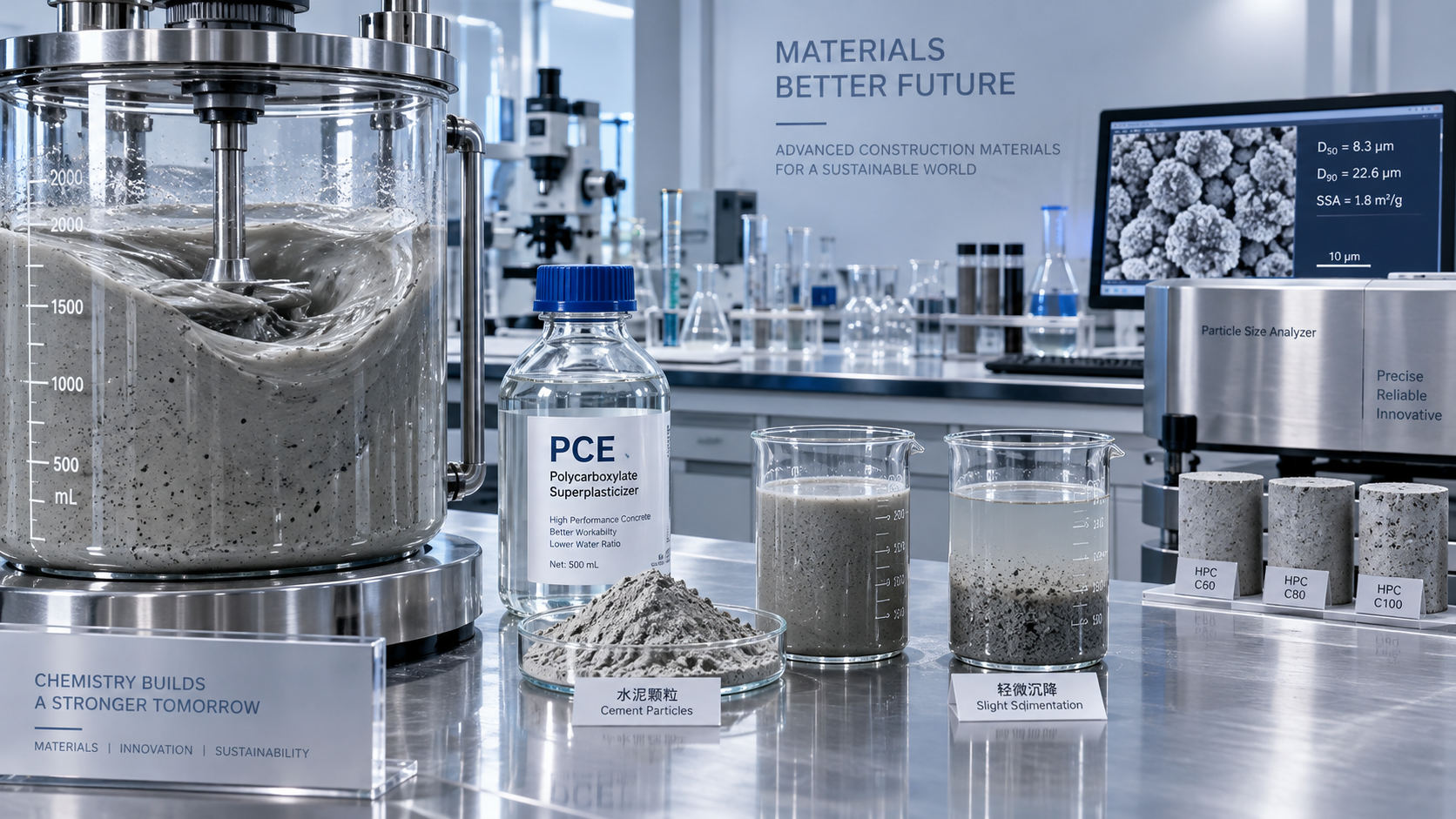
Compatibility problems with construction admixtures arise when a chemical admixture does not produce the expected result in a specific concrete system. The admixture may be sound, the cement may meet its specification, and the mix design may look correct on paper—yet the combined system can show rapid slump loss, abnormal setting, excessive air, poor strength development, segregation, or unstable pumping behavior.
The key point is that compatibility is not a fixed property of an admixture. It is an interaction between cement, supplementary cementitious materials, aggregates, water, admixture chemistry, dosage sequence, temperature, and mixing practice. A superplasticizer that performs well with one cement source can behave very differently after a change in clinker composition, gypsum form, limestone addition, or cement grinding conditions. This is why construction admixture compatibility must be assessed at the concrete-system level rather than by comparing product data sheets alone.
Compatibility is different from basic product quality
A common commercial misunderstanding is to treat an unexpected concrete result as proof that either the cement or the admixture is defective. Sometimes that is true. More often, the problem is an unfavorable interaction between otherwise acceptable materials.
For example, a polycarboxylate ether (PCE) water reducer works by adsorbing onto cement particles and dispersing them through electrostatic and steric effects. Its performance depends on how much polymer is available in the pore solution, how quickly it adsorbs, and which mineral phases compete for it. If a particular cement absorbs the polymer too rapidly, the concrete may initially flow well but lose workability quickly. If adsorption is delayed or incomplete, the expected water reduction may not be achieved.
The same principle applies to set retarders, accelerators, air-entraining agents, viscosity-modifying admixtures, shrinkage-reducing admixtures, and hydration-control products. “Compatible” does not mean that two materials can simply be mixed without a visible reaction. It means that, at the intended dosage and under site conditions, the complete mix can consistently meet required fresh and hardened concrete properties.
Cement chemistry is usually the first variable to examine
Cement is not chemically uniform across suppliers, plants, or even production periods. Its nominal strength class does not reveal all the characteristics that govern admixture response. The most influential variables include clinker mineralogy, sulfate balance, alkali content, fineness, limestone content, and the form and quantity of calcium sulfate used during grinding.
Tricalcium aluminate (C3A) is particularly important in admixture compatibility. It reacts rapidly with water and sulfate phases and can strongly affect the adsorption of water reducers. A cement with higher reactive aluminate content may consume a larger portion of a PCE or naphthalene-based superplasticizer early in mixing. The remaining free admixture may then be insufficient to maintain dispersion, leading to accelerated slump loss.
Sulfate balance is equally significant. Cement producers use gypsum, hemihydrate, anhydrite, or combinations of these materials to control aluminate hydration. Their dissolution rates differ. If available sulfate is too low relative to reactive aluminates, concrete can stiffen rapidly, and a water reducer may appear ineffective. If sulfate release is delayed, the mix may show an unusual evolution of fluidity: poor initial workability followed by later loosening, or acceptable early slump followed by instability.
Fineness changes the picture further. Finer cement has greater surface area and can demand more water and more dispersant. A purchaser who substitutes a finer cement of the same grade without revalidating admixture dosage may see reduced slump retention or higher admixture consumption. This is not necessarily evidence that the previous admixture package has failed; the adsorption demand of the binder system has changed.
Different superplasticizer families do not fail in the same way
Water reducers are often discussed as though they form one interchangeable category. Their chemical mechanisms and practical limits differ substantially. Selection should consider not only initial water reduction but also the required transport time, placing method, cement source, temperature range, and whether slump retention is needed from the main admixture or through a separate retention component.
PCE chemistry deserves particular caution because products grouped under the same broad name can behave very differently. Molecular weight, backbone structure, side-chain density, charge distribution, and retention design all influence adsorption and dispersion. Two PCE products with similar solids content may not be substitutes. Replacing one with another solely on the basis of water-reduction claims can alter set time, viscosity, air content, and slump retention.
Compatibility also has a time dimension. A product may give excellent initial spread but lose slump before discharge. Another may retain flow but create excessive retardation at low temperature. Comparing admixtures only at five or ten minutes after mixing misses the condition that matters in ready-mix delivery, pumping, or extended placement.
Supplementary cementitious materials change the adsorption environment
Fly ash, ground granulated blast-furnace slag, silica fume, calcined clay, and limestone powder can improve concrete performance when properly proportioned, but they also change admixture demand. Their particle size, surface chemistry, carbon content, glass content, and reactivity influence the amount of admixture available to disperse cement particles.
Silica fume is a clear example. Its extremely fine particles raise surface area and can increase water demand. Without a suitable PCE system and appropriate viscosity control, a low water-binder ratio silica-fume concrete may become sticky, difficult to pump, or highly sensitive to small water changes. This is not simply a matter of adding more superplasticizer. Excess dosage can introduce segregation, delayed setting, or an unstable rheological profile.
Calcined clays and other alumina-rich materials may create stronger competition for PCE adsorption than conventional fly ash. Their use therefore requires separate compatibility testing rather than an assumption that a dosage established for ordinary Portland cement concrete will transfer directly. Carbon-bearing constituents in some fly ashes can also interfere with air-entraining admixtures by adsorbing the surfactants needed to stabilize the air-void system.
Limestone powder is often treated as chemically passive, but it can still affect particle packing, water demand, and the early-age hydration environment. A cementitious blend can therefore change fresh concrete behavior even when its compressive-strength target remains unchanged.
Water quality and aggregate contamination are underestimated causes
Water from different sources can vary in dissolved salts, alkalinity, hardness, suspended solids, and organic contamination. These differences may affect admixture performance, especially for mixes designed near the limit of workable water content. Hard water can change the behavior of certain surfactant-based admixtures. Water containing sugars, organic matter, or process residues may alter setting behavior. Recycled wash water introduces additional uncertainty because its solids content and dissolved-ion concentration can fluctuate between batches.
Aggregate quality matters for the same reason. Fine aggregate with high clay or silt content can adsorb PCE molecules, leaving less active polymer available for cement dispersion. The concrete may require unexpectedly high admixture dosage, lose slump quickly, or become inconsistent across loads. Clay contamination is particularly problematic because the apparent solution—raising the dosage—may increase cost without restoring predictable performance.
Moisture variation in sand creates a more basic but equally serious compatibility illusion. If actual free water differs from the assumed value, concrete may look like it has suffered chemical incompatibility when the primary issue is water-binder ratio drift. Before changing admixture suppliers or increasing dosage, the batching plant should confirm aggregate moisture measurement, water correction, and the uniformity of fines.
Sequence, dilution, and mixing energy can change the result
Construction admixtures are not always added at the same stage. A superplasticizer introduced with initial mixing water can behave differently from the same product added after the cement has begun to hydrate. Delayed addition is sometimes used to improve dispersion, but its value depends on the binder and the specific product. A sequence that improves one concrete can create delayed response or excessive fluidity in another.
Incompatible admixtures may also result from direct product-to-product contact. Certain accelerator, retarder, air-entraining, viscosity-modifying, and water-reducing formulations are not intended to be premixed in concentrated form. Localized precipitation, phase separation, viscosity change, or loss of activity can occur before the chemicals ever reach the concrete. Products should be introduced separately unless the supplier has confirmed storage and blending compatibility.
Mixing time and energy are practical variables, not minor operational details. Insufficient mixing can leave the admixture unevenly distributed and produce misleading test results. Excessive mixing, especially in hot conditions, can accelerate slump loss through temperature rise and evaporation. Changes in mixer type, truck-mixer condition, or batching sequence should therefore trigger verification, even if the approved raw materials have not changed.
Temperature turns a manageable interaction into a field problem
Temperature affects cement hydration, admixture adsorption, water evaporation, and air stability. High concrete temperature can shorten the workable period and increase the apparent demand for a slump-retaining admixture. Low temperature can slow hydration and amplify the retarding effect of some water reducers or set-control agents.
The interaction becomes more complex when chemical accelerators are used. Non-chloride accelerators, especially those based on nitrate, nitrite, formate, aluminate, or other salts, can alter the response of water reducers and retarders. Their influence on setting cannot be inferred from each product’s individual technical data. The combined system must be tested at the proposed dosage and curing temperature.
Chloride-containing accelerators require separate caution because reinforcement corrosion risks and applicable specifications may restrict or prohibit their use in reinforced or prestressed concrete. Compatibility testing does not replace compliance review. A chemically effective combination may still be unsuitable for the structure.
The symptoms point to different root causes
Not every fresh-concrete problem should be diagnosed as “poor compatibility.” The pattern of symptoms helps narrow the investigation.
- Good initial slump followed by rapid loss: often associated with high adsorption demand, poor sulfate balance, elevated temperature, excessive clay fines, or a superplasticizer with insufficient retention for the delivery window.
- Low initial slump despite the normal dosage: may indicate a cement change, higher binder fineness, reduced batch water, inadequate mixing, or a PCE being consumed by clay or reactive supplementary materials.
- Unexpectedly long setting: can result from excessive water reducer or retarder dosage, low temperature, a change in cement sulfate conditions, high replacement levels of slow-reacting binder components, or unintended chemical interactions.
- Flash set or false set behavior: may be linked to sulfate-form changes, cement storage conditions, insufficient available sulfate, or a disruptive interaction between the cement and admixture package.
- Excessive air or unstable air content: can arise from the water reducer, air-entraining agent, aggregate fines, mixing energy, defoamer interaction, or carbonaceous material in supplementary cementitious materials.
- Segregation, bleeding, or poor pumpability: often reflects rheology rather than simple slump. Water reduction, paste volume, sand grading, viscosity modifier selection, and admixture overdose all need to be considered together.
Strength results should be interpreted with the same discipline. Low early strength may be caused by retardation, excess water, reduced curing temperature, altered cement reactivity, or air entrainment. A single compressive-strength result cannot identify which variable is responsible.
Compatibility testing should reproduce the real production system
A useful evaluation does not begin with a generic mortar test and end with a purchase decision. Mortar screening can compare basic response, but concrete trials must reflect the intended cement, supplementary materials, aggregates, mixing equipment, water source, transport duration, and placing temperature.
Testing should measure more than initial slump or flow. Relevant observations include water demand, spread retention over the required working period, air content, density, temperature, setting behavior, bleeding, segregation resistance, pumpability where applicable, and early and later-age strength. Where surface finish, precast release timing, or freeze-thaw durability is important, those requirements should also be part of the approval criteria.
One of the most useful comparisons is not between two admixtures at a single dosage, but between their dosage-response curves. A product that achieves the target slump at a lower dosage may have a narrow tolerance window. Another may require more dosage but remain stable despite modest variation in moisture, temperature, or cement properties. The second option can be operationally safer even when its unit cost is higher.
Control changes instead of reacting to each bad batch
Reliable compatibility management depends on change control. Any change in cement plant, cement type, supplementary material source, admixture formulation, aggregate source, recycled-water ratio, or seasonal temperature practice should be treated as a potential concrete-system change. Certificates of analysis are useful, but they cannot fully predict field rheology.
For purchasing and cross-border supply decisions, technical documentation should clarify active solids, density, chloride content where relevant, recommended dosage range, storage conditions, shelf life, and whether the product is intended for particular binder systems. Batch-to-batch consistency, transport conditions, and storage temperature can matter as much as the stated chemistry. Freezing, overheating, prolonged storage, or contamination in tanks can change an admixture’s usable properties before it enters production.
The practical answer to what causes construction admixture compatibility problems is therefore not a single chemical fault. Problems emerge when a material designed for one hydration and rheology environment is used in another without verifying the interaction. The most dependable approach is to compare complete admixture systems under realistic conditions, identify the variables that genuinely changed, and approve performance based on the required placing window and hardened-concrete outcome—not on initial slump or product category alone.
Bugün Bize Talebinizi Gönderin